Monday, March 4, 2013

Sky Events March 2013


Moon Phases

Mon., March 4, 4:53 p.m. EST

Last Quarter Moon

The last or third quarter moon rises around 12:30 a.m. and sets around 10:30 a.m. It is most easily seen just after sunrise in the southern sky.

Mon., March 11, 3:51 p.m. EDT

New Moon

The moon is not visible on the date of new moon because it is too close to the sun, but can be seen low in the east as a narrow crescent a morning or two before, just before sunrise. It is visible low in the west an evening or two after new moon.

Tue., March 19, 1:27 p.m. EDT

First Quarter Moon

The first quarter moon rises around 11 a.m. and sets around 1:30 a.m. It dominates the evening sky.

Tue., March 27, 5:27 a.m. EDT

Full Moon

The full moon of March is called the Storm Moon. Its Cree name is Migisupizum, meaning “eagle moon.” Other names are Crow Moon, Crust Moon, Sugar Moon, Sap Moon, Chaste Moon, Death Moon, Worm Moon and Lenten Moon. In Hindi it is known as Basanta Purnima or Dol Purnima. Its Sinhala (Buddhist) name is Medin. The full moon rises around sunset and sets around sunrise, the only night in the month when the moon is in the sky all night long. The rest of the month, the moon spends at least some time in the daytime sky.


Observing Highlights

Fri., March 1, late evening

Spica north of the moon

The moon will be close to the bright star Spica. Observers in the central Pacific Ocean and Central America will see the moon occult Spica. Look for Saturn rising below and to the left of the moon and Spica.

Thu., March 7, just after sunset

Comet C/2011 L4 (Wainscoat/PANSTARRS)

Look for this comet just after sunset, above and to the left of the sun, tonight and for the next couple of weeks.

Sun., March 17, early evening

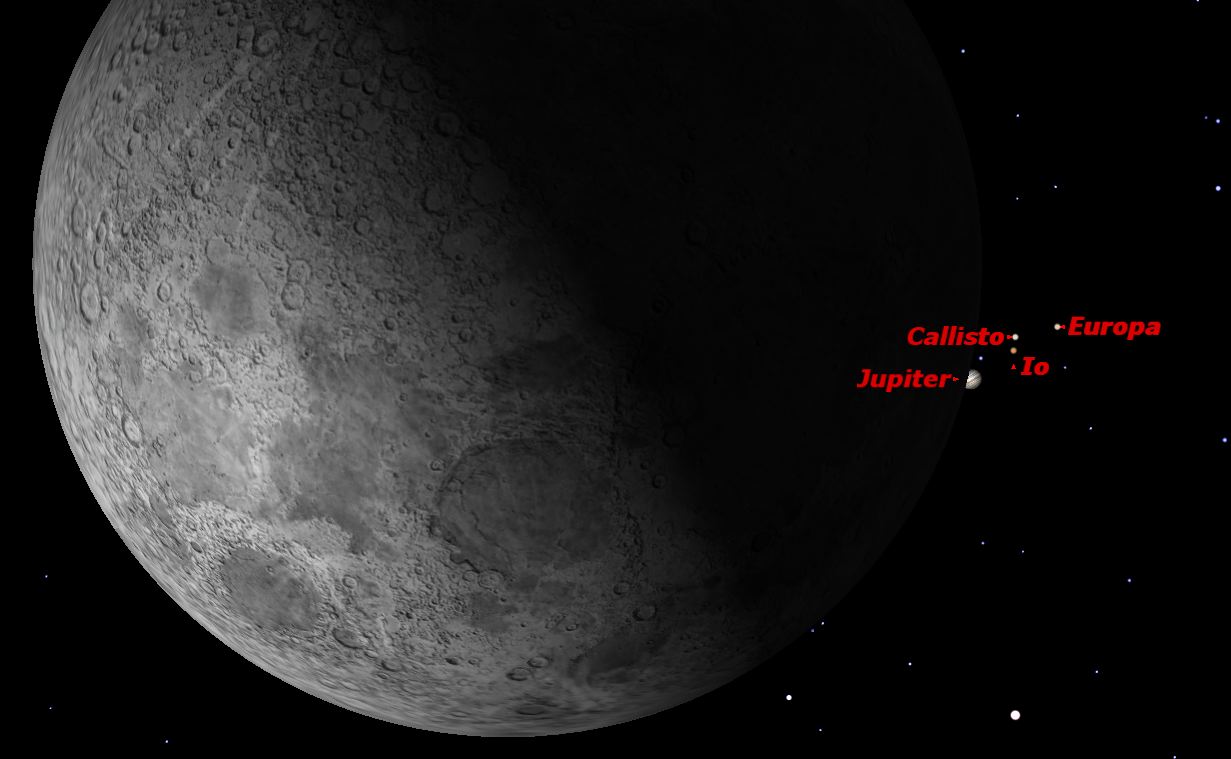
Jupiter and the Moon

Another close conjunction between Jupiter and the Moon, close to Aldebaran and the Hyades. Say farewell to the Pleiades and the Orion Nebula, now sinking fast in the west.

Wed., March 20, 7:02 a.m. EDT

Vernal equinox

The Sun crosses the celestial equator heading north, marking the beginning of Spring in the Northern Hemisphere. Notice the close gathering of the planets Uranus, Mars and Venus close to the Sun: all are on the far side of the Sun relative to Earth..

Wed., March 27, early evening

Spica and the Moon

For the second time this month, the moon passes close to Spica. This time the moon will occult Spica for observers in southeast Asia, northern Australia, and the many islands to the west, north and east.

Sun., March 31, morning twilight

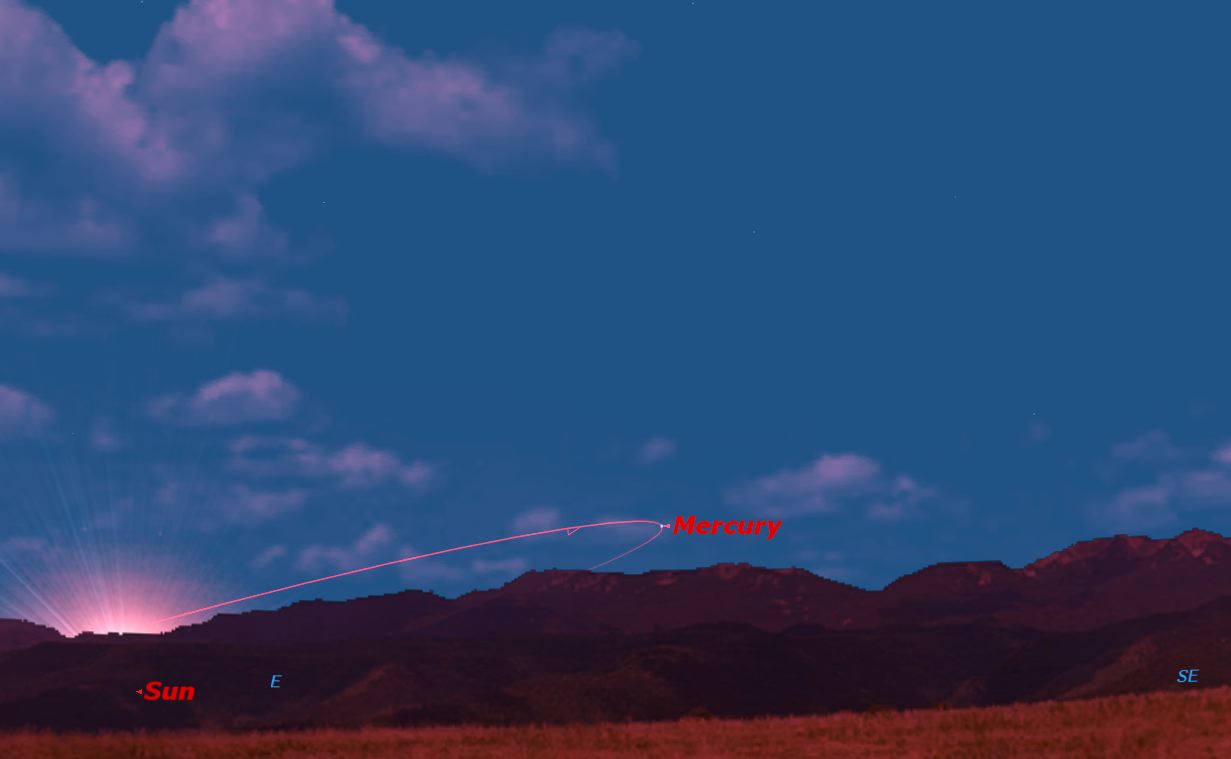
Mercury at greatest elongation west

This is not a good opportunity for observers in the Northern Hemisphere to observe Mercury in the morning sky, as shown here; Mercury will be much higher for observers in the Southern Hemisphere. Sweep the eastern horizon with binoculars to pick up Mercury’s tiny speck of light.

Planets


Mercury will be in the eastern  sky towards the end of the month, the best opportunity for observers in the Southern Hemisphere to see it as an “morning star” in 2013.

Venus is now very low in the southeast at sunrise, and will be superior conjunction with the sun on March 28, moving into the evening sky.

Mars has faded into the west moving behind the sun. It spends most of the month in the constellation Pisces.

Jupiter continues its stay in Taurus close to Aldebaran and the Hyades. It is high in the southwestern sky in the early evening and sets in the northwest around 1 a.m.

Saturn is spends the month in western Libra. It rises in the east at around 11:30 p.m., and is visible the rest of the night.

Uranus is in Pisces but too close to the sun to be observed.

Neptune is in Aquarius all month, too close to the sun to be observed.

Geoff Gaherty
Starry Night Software Support
All graphics © 2013 Starry Night Software

Monday, January 28, 2013

Sky Events February 2013


Moon Phases

Sun., February 3, 10:56 a.m. EST

Last Quarter Moon

The last or third quarter moon rises around 1 a.m. and sets around 11 a.m. It is most easily seen just after sunrise in the southern sky.

Sun., February 10, 2:20 a.m. EST

New Moon

The moon is not visible on the date of new moon because it is too close to the sun, but can be seen low in the east as a narrow crescent a morning or two before, just before sunrise. It is visible low in the west an evening or two after new moon.

Sun., February 17, 3:31 p.m. EST

First Quarter Moon

The first quarter moon rises around 11 a.m. and sets around 2 a.m. It dominates the evening sky

Mon., February 25, 3:26 p.m. EST

Full Moon

The full moon of February is called the Snow Moon. Its Cree name is Cepizun, meaning “old moon.” Other names are Hunger Moon, Storm Moon and Candles Moon. In Hindi it is known as Magh Poornima. Its Sinhala (Buddhist) name is Navam. The full moon rises around sunset and sets around sunrise, the only night in the month when the moon is in the sky all night long. The rest of the month, the moon spends at least some time in the daytime sky.


Observing Highlights

Fri., February 1, 9 p.m. EST

Spica north of the moon

The moon will be close to the bright star Spica. Observers in southern Africa and eastern Australia will see the moon occult Spica.

Fri., February 8, 4 p.m. EST

Mercury north of Mars

The two planets Mercury and Mars will be in a close conjunction. Since both are close to the sun, this will be difficult to observe, as there is only a narrow window between when the sky gets dark enough after sunset and when the two planets are high enough above the horizon to still be visible. Binoculars or a telescope recommended

Sat., February 16, evening twilight

Mercury at greatest elongation east

This is the best opportunity this year for observers in the Northern Hemisphere to observe Mercury in the evening sky. Sweep the western horizon with binoculars to pick up Mercury’s tiny speck of light.

Mon., February 18, early evening

Jupiter and the Moon

Another close conjunction between Jupiter and the Moon, flanked by Aldebaran and the Hyades to the left and the Pleiades to the right. The Moon will actually pass in front of Jupiter for viewers in the southern Indian Ocean. Southern Australia and Tasmania. Shown here is the view from Melbourne, Australia.

Mon., February 18, early evening

Vesta and the Moon

The moon will pass just south of the bright asteroid Vesta, making it easier to locate than usual. The moon will occult Vesta as seen from central South America and much of western and southern Africa.


Planets


Mercury will be well placed in the western  sky for most of the month, the best opportunity to see it as an “evening star” in 2013.

Venus is now very low in the southeast at sunrise, heading towards superior conjunction with the sun on March 28.

Mars has faded into the west moving behind the sun. It rapidly crosses the entire constellation of Aquarius this month. Mars passes just south of Neptune on February 4, but Neptune will probably be too dim to see in evening twilight.

Jupiter remains in Taurus, close to Aldebaran and the Hyades. It is high in the southern sky in the early evening and sets in the northwest around 2 a.m.

Saturn is spends the month in western Libra. It rises in the east at around midnight, and is visible the rest of the night.

Uranus is visible in Pisces in the early evening and sets around 9 p.m.

Neptune is in Aquarius all month, becoming lost in the twilight close to the sun. It is in conjunction with the sun on February 21.

Geoff Gaherty
Starry Night Software Support
All graphics © 2013 Starry Night Software

Monday, January 7, 2013

Sky Events January 2013


Moon Phases

Fri., January 4, 10:58 p.m. EST

Last Quarter Moon

The last or third quarter moon rises around midnight and sets around noon. It is most easily seen just after sunrise in the southern sky.

Fri., January 11, 2:44 p.m. EST

New Moon

The moon is not visible on the date of new moon because it is too close to the sun, but can be seen low in the east as a narrow crescent a morning or two before, just before sunrise. It is visible low in the west an evening or two after new moon.

Fri., January 18, 6:45 p.m. EST

First Quarter Moon

The first quarter moon rises around 11 a.m. and sets around 1 a.m. It dominates the evening sky

Sat., January 26, 11:38 p.m. EST

Full Moon

The full moon of January is called the Wolf Moon. Its Cree name is Gishepapiwatekimumpizun, meaning “moon when the old fellow spreads the brush.” Other names are Moon After Yule, Ice Moon and Old Moon. In Hindi it is known as Paush Poornima. Its Sinhala (Buddhist) name is Duruthu. The full moon rises around sunset and sets around sunrise, the only night in the month when the moon is in the sky all night long. The rest of the month, the moon spends at least some time in the daytime sky.


Observing Highlights

Thu., January 3, midnight–dawn local time

Quadrantid meteor shower

One of the finest meteor showers of the year, though a waning gibbous moon will interfere with the view. The Quadrantids take their name from an obsolete constellation, Quadrans Muralis, now part of Boötes.

Thu., January 10, sunrise

Venus and the Moon

Venus and the Moon will be in a close conjunction low in the southeast at sunrise. Because Venus is on the far side of its orbit, heading towards superior conjunction with the Sun on March 28, it will be 95% illuminated, while the Moon, just a day away from New Moon, will be only 2% illuminated.

Mon., January 21, 10 p.m. EST

Jupiter and the Moon

A close conjunction between Jupiter and the Moon, flanked by Aldebaran and the Hyades to the left and the Pleiades to the right. The Moon will actually pass in front of Jupiter for viewers in the South Pacific Ocean and central South America.


Planets


Mercury will be too close to the Sun for observation this month.

Venus is now low in the southeast at sunrise, heading towards superior conjunction with the Sun on March 28.

Mars has faded into the west moving behind the sun. It moves from Capricornus into Aquarius on January 29.

Jupiter remains in Taurus, close to Aldebaran and the Hyades. It is high in the eastern sky at sunset and sets in the northwest around 3 a.m.

Saturn is spends the month in western Libra. It rises in the east at around 1 a.m., and is visible the rest of the night.

Uranus is visible in Pisces in the early evening and sets around 10 p.m.

Neptune is in Aquarius all month, becoming lost in the twilight close to the Sun.

Geoff Gaherty
Starry Night Software Support
All graphics © 2013 Starry Night Software

Saturday, December 1, 2012

Sky Events December 2012


Moon Phases

Thu., December 6, 10:31 a.m. EST

Last Quarter Moon

The last or third quarter moon rises around 11:30 p.m. and sets around 12:15 p.m. It is most easily seen just after sunrise in the southern sky.

Thu., December 13, 3:42 a.m. EST

New Moon

The moon is not visible on the date of new moon because it is too close to the sun, but can be seen low in the east as a narrow crescent a morning or two before, just before sunrise. It is visible low in the west an evening or two after new moon.

Thu., December 20, 12:19 a.m. EST

First Quarter Moon

The first quarter moon rises around 11:45 a.m. and sets around 12:30 a.m. It dominates the evening sky

Fri., December 28, 5:21 a.m. EST

Full Moon

The full moon of December is called the oak moon. Other names are frost moon, winter moon, long night’s moon, and moon before Yule. In Hindi it is known as margashirsha poornima. Its Sinhala (Buddhist) name is unduvap. The full moon rises around sunset and sets around sunrise, the only night in the month when the moon is in the sky all night long. The rest of the month, the moon spends at least some time in the daytime sky.


Observing Highlights

Sun., December 2, 9 p.m. EST

Jupiter at opposition

Jupiter is directly opposite the sun and, as a result, shines brightly all night long. Because Jupiter is above the horizon for longer than its rotation period, it is possible to watch an entire rotation of the planet in one night. Jupiter joins a circle of seven of the brightest stars in the sky: Sirius, Procyon, Pollux, Castor, Capella, Aldebaran, and Rigel, with Betelgeuse at its center.

Tue., December 4, dawn

Mercury at greatest elongation west

The best morning apparition of the year for the elusive planet Mercury. Venus and Saturn will point to the tiny glimmer of Mercury, best seen about an hour before sunrise.

Sun., December 9, 3 a.m. EST

Vesta at opposition

Now that Ceres has been promoted from an asteroid to a dwarf planet, Vesta has become the largest and brightest of the asteroids. Tonight, at magnitude 6.2, it is slightly too faint to be visible naked eye, but is an easy object in binoculars.

Tue., December 11, dawn

Mercury,  Venus and the moon

The slender waning crescent moon passes just below Venus, with Mercury nearby.

Fri., December 14, midnight–dawn

Geminid meteor shower

One of the finest meteor showers of the year, without a moon to block the view.

Tue., December 18, 4 a.m. EST

Ceres at opposition

Once the largest asteroid, Ceres has now been reclassified as a dwarf planet. At magnitude 6.6, it is an easy target in binoculars. Notice that Ceres is close to Vesta in the sky. The Dawn spacecraft, after spending nearly 14 months studying Vesta, left on September 5 to rendezvous with Ceres in February 2015.

Tue., December 25, 7 p.m. EST

Jupiter and the moon

The moon will pass just south of Jupiter soon after moonrise in the eastern sky. The two brightest star clusters in the sky, the Hyades and the Pleiades, are nearby.


Planets


Mercury will be well placed in the morning sky for observers in the northern hemisphere for the first half of the month.

Venus is still a morning “star,” shining brightly before sunrise. It moves from Libra through Scorpius into Ophiuchus during the month, sinking lower into morning twilight as it moves towards superior conjunction with the Sun on March 28.

Mars has faded into the west moving behind the sun. It moves from Sagittarius into Capricornus on December 25.

Jupiter is in Taurus, close to Aldebaran and the Hyades. It reaches opposition on December 2 and is visible all night long.

Saturn is now a morning star. It begins the month in Virgo, but moves into Libra on December 6.

Uranus is visible all evening in Pisces. It sets around 1 a.m.

Neptune remains in the depths of Aquarius all month, and sets around 10 p.m.

Geoff Gaherty
Starry Night Software Support
All graphics © 2012 Starry Night Software

Friday, November 2, 2012

November 2012 Sky Events


Moon Phases

Tue., November 6, 7:36 p.m. EST

Last Quarter Moon

The last or third quarter moon rises around 11:45 p.m. and sets around 1:15 p.m. It is most easily seen just after sunrise in the southern sky.

Tue., November 13, 5:08 p.m. EST

New Moon

The moon is not visible on the date of new moon because it is too close to the sun, but can be seen low in the east as a narrow crescent a morning or two before, just before sunrise. It is visible low in the west an evening or two after new moon.

Tue., November 20, 9:31 a.m. EST

First Quarter Moon

The first quarter moon rises around 1:00 p.m. and sets around 12:15 a.m. It dominates the evening sky

Wed., November 28, 9:46 a.m. EST

Full Moon

The full moon of November is called the beaver moon. In Algonquian it is called the “much white frost on grass” moon. Other names are frost moon, snow moon and hunter's moon. In Hindi it is known as kartik poornima. Its Sinhala (Buddhist) name is il. The full moon rises around sunset and sets around sunrise, the only night in the month when the moon is in the sky all night long. The rest of the month, the moon spends at least some time in the daytime sky.


Observing Highlights

Thu., November 1, 9 p.m.

Jupiter and the moon

The moon will pass just south of Jupiter soon after moonrise in the eastern sky.

Sun., November 11, 6 a.m.

Venus, Spica and the moon

About an hour before sunrise, The Moon joins the planet Venus and the bright star Spica in the morning sky.

Wed., November 14, morning

Total eclipse of the sun

The path of this eclipse crosses northern Queensland, Australia before heading out across the Pacific Ocean. It will be visible as a partial eclipse over all of Australia and New Zealand, as well as most of the southern Pacific Ocean and southwestern South America.

Sat., November 17, 3 a.m.

Leonid meteor shower peaks

The Leonid meteor shower has at times produced incredible storms of meteors. This year is not predicted to be anything out of the ordinary, but there’s always a chance of seeing a good number of meteors, especially this year since there will be no Moon in the sky after midnight when meteors are most frequent.

Tue., November 27, before sunrise

Venus and Saturn in conjunction

A close approach between Venus and Saturn provides a rare opportunity to see two planets in the same telescope field, as well as being a treat for the unaided eye. Venus will be far brighter than Saturn.

Wed., November 28, 9 p.m.

Jupiter and the moon

The moon will again pass just south of Jupiter soon after moonrise in the eastern sky.

Wed./Thu., November 28/29

Penumbral eclipse of the moon

This eclipse is best viewed in Asia, Australasia, and the northwestern Pacific Ocean. It will be at maximum near the middle of  the night, on the night which begins on the 28th and ends on the 29th. The moon will only be passing through the Earth’s penumbral shadow (outer circle), so will only be slightly shaded at maximum eclipse; you will need to look closely to see the shading.


Planets


Mercury is too close to the sun all month to be observed.

Venus is still a morning “star,” shining brightly before sunrise. It spends most of the month in Virgo, crossing into Libra on November 27.

Mars has faded into the west moving behind the sun. It moves from Ophiuchus into Sagittarius on November 12.

Jupiter is now in Taurus, close to Aldebaran and the Hyades. It rises about an hour after sunset, and is visible the rest of the night.

Saturn reappears from behind the sun in the morning sky around the middle of the month, just in time for a spectacular conjunction with Venus on November 27.

Uranus is visible most of the night in Pisces. It sets around 3 a.m.

Neptune remains in the depths of Aquarius all month, and sets around midnight.

Geoff Gaherty
Starry Night Software Support
All graphics © 2012 Starry Night Software

Friday, September 28, 2012

October 2012 Sky Events

 
-->

Moon Phases

Mon., October 8, 3:33 a.m. EDT

Last Quarter Moon

The last or third quarter moon rises around 11:15 p.m. and sets around 2:50 p.m. It is most easily seen just after sunrise in the southern sky.


Mon., October 15, 8:02 a.m. EDT

New Moon

The moon is not visible on the date of new moon because it is too close to the sun, but can be seen low in the east as a narrow crescent a morning or two before, just before sunrise. It is visible low in the west an evening or two after new moon.

Sun., October 21, 11:32 p.m. EDT

First Quarter Moon

The first quarter moon rises around 2:00 p.m. and sets around 12:20 a.m. It dominates the evening sky

Mon., October 29, 3:49 p.m. EDT

Full Moon

The full moon of October is called the hunter's moon. In Algonquian it is called the white frost on grass moon. Other names are travel moon, dying grass moon, blood moon and harvest moon. In Hindi it is known as kojagiri or sharad purnima or lakshmi puja. Its Sinhala (Buddhist) name is vap. The full moon rises around sunset and sets around sunrise, the only night in the month when the moon is in the sky all night long. The rest of the month, the moon spends at least some time in the daytime sky.


Observing Highlights

Wed., October 3, 4 a.m.

Venus  and Regulus

Venus will pass just south of the first magnitude star Regulus this morning. Venus now looks like a tiny waning gibbous moon, 72% illuminated, within the same telescope field as Regulus.

Thu., October 4, 11 p.m.

Jupiter and friends at moonrise

As the moon rises this evening, it is in the midst of the Pleiades and the Hyades, and is joined by the red giant star Aldebaran and the planet Jupiter. The same cast appears tomorrow at moonrise, but the moon has moved to the left of Jupiter. Observers in southern Australia will see the moon occult Jupiter.

Sat., October 13–27, pre-dawn

Zodiacal light

The faint glow of the zodiacal light will rise in the east ahead of the sun along the line of the ecliptic, as marked by Venus and Regulus. Don’t confuse it with the faint glow of the Milky Way in the southeast, marked by Sirius and Procyon.

Wed., October 17, sunset

Mars, Mercury and the moon

The 3-day-old crescent moon framed by the planets Mars and Mercury will be a challenge for northern observers unless they have a very low southwestern horizon. Observers in the southern hemisphere will have a much better view.

Sun., October 21, midnight–dawn

Orionid meteor shower

The Orionids are remnants of Halley’s Comet scattered along its orbit, one of the finest meteor showers in the year. The meteors appear to radiate from a point just between Orion’s club and the Gemini twins’ feet, but may be seen anywhere in the sky.

Fri.–Sat., October 26–27, sunset

Mercury at greatest eastern elongation

The first view is from northeastern North America, where the angle of the ecliptic at sunset is very close to the horizon, making Mercury (and Mars) hard to see.

The second view is from southern Australia about 12 hours later, where the ecliptic is perpendicular to the horizon, making Mercury (and Mars) much easier to see.


Planets


Mercury is at greatest eastern elongation from the sun on October 26, appearing low on the southwestern horizon about an hour after sunset. This apparition favors observers in the southern hemisphere.

Venus is now a morning “star,” shining brightly before sunrise. It begins the month in Leo, crossing into Virgo on October 23.

Mars is fading into the west towards the sun. It moves from Libra through Scorpius into Ophiuchus during the month. Mars is low in the southwest at sunset and sets around 8:00 p.m..

Jupiter is now well placed most of the night in Taurus. It rises around 9 p.m.

Saturn is too close to the sun to be observed, being in conjunction with the sun on October 25.

Uranus is visible most of the night in Pisces.

Neptune remains in the depths of Aquarius all month, and is visible most of the night, setting at 3 a.m.

Geoff Gaherty
Starry Night Software Support