Sunday, November 1, 2015

Sky Events November 2015

Moon Phases

Tuesday, November 3, 7:24 a.m. EST

Last Quarter Moon

The Last Quarter Moon rises around 11 p.m. and sets around 1 p.m. It is most easily seen just after sunrise in the southern sky.

Wednesday, November 11, 12:47 p.m. EST

New Moon

The Moon is not visible on the date of New Moon because it is too close to the Sun, but can be seen low in the East as a narrow crescent a morning or two before, just before sunrise. It is visible low in the West an evening or two after New Moon.

Thursday, November 19, 1:27 a.m. EST

First Quarter Moon

The First Quarter Moon rises around 12:30 p.m. and sets around 11:30 p.m. It dominates the evening sky.

Wednesday, November 25, 5:44 p.m. EST

Full Moon

The November Full Moon is known as the Beaver Moon or Frosty Moon. It rises around sunset and sets around sunrise; this is the only night in the month when the Moon is in the sky all night long. The rest of the month, the Moon spends at least some time in the daytime sky.


Observing Highlights

Venus and Mars

Tuesday, November 3, dawn

Venus and Mars are less than a degree apart, with Jupiter nearby. Venus is by far the brightest of the three, with Mars a tiny red dot just above brilliant white Venus.

Jupiter and the Moon

Friday, November 6, dawn

Jupiter will be 2 degrees north of the Moon, with Mars and Venus nearby.

Venus and the Moon

Saturday, November 7, dawn

Venus will be 1.2 degrees north of the Moon, with Mars and Jupiter nearby.

Leonid meteors

Wednesday, November 18, midnight to dawn

Although not predicted to be active this year, this shower has often performed well in the past, and is worth a look.

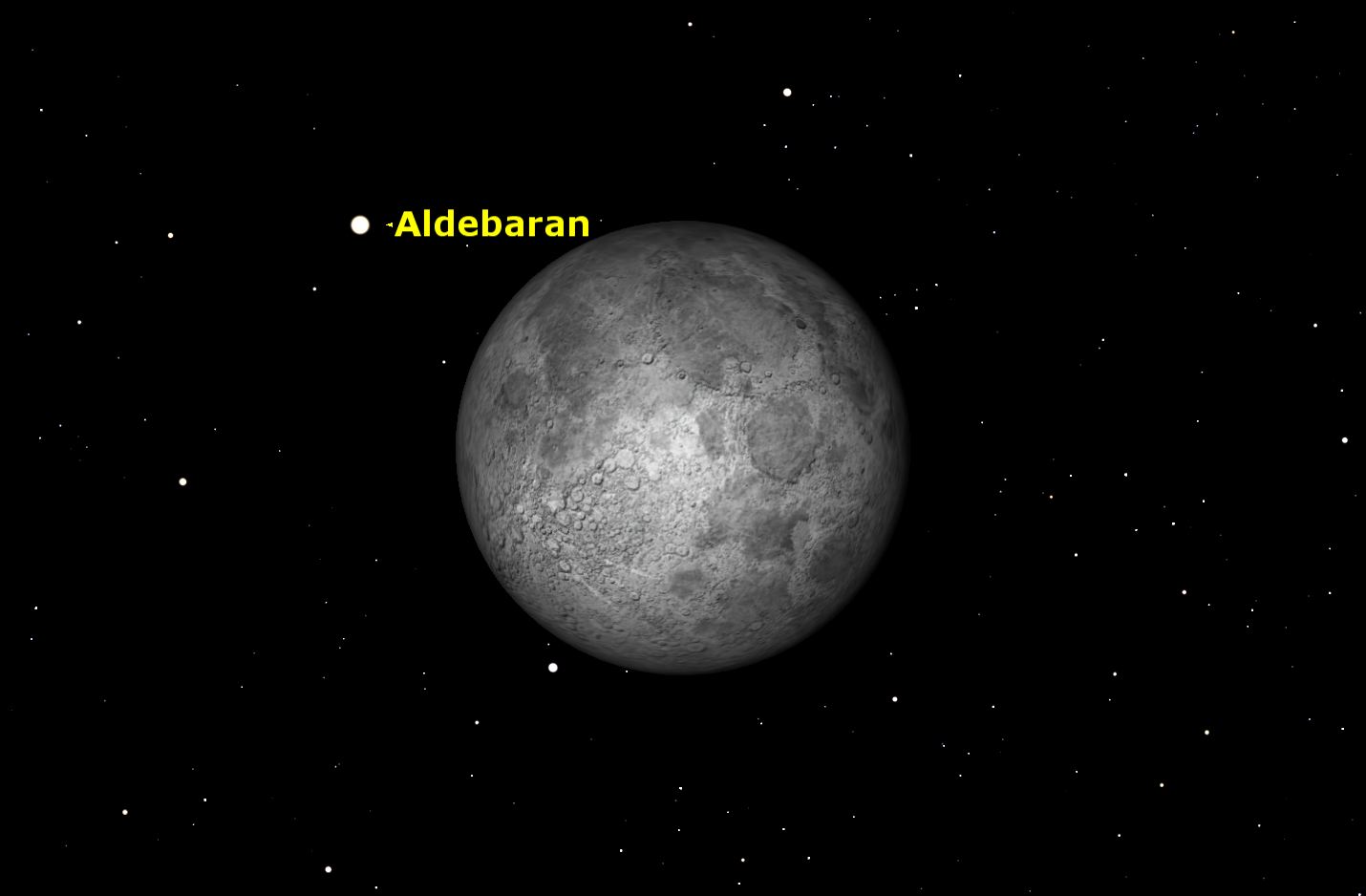
Occultation of Aldebaran

Thursday, November 26, before sunrise

For observers in Canada and the northern USA, the Moon will pass in front of the bright red giant star Aldebaran in Taurus. The exact times of disappearance and reappearance will vary depending on your location. A program like Starry Night will give you the exact times for your location.

Planets

Mercury is too close to the Sun to be observed this month.


Venus continues to shine brightly at dawn all month.


Mars, in the morning sky, moves from Leo into Virgo on November 1, and continues to move eastward in Virgo for the rest of the month. It starts the month close to Jupiter, and ends it halfway between Jupiter and Venus.


Jupiter shines brightly in Leo in the eastern pre-dawn sky all month.


Saturn is too close to the Sun to be observed all month.


Uranus is well placed in Pisces in the evening sky all month.


Neptune is well placed in the evening sky all month in the constellation Aquarius.


Geoff Gaherty
Starry Night Software Support
All graphics © 2015 Starry Night Software

Friday, October 2, 2015

Sky Events October 2015

Moon Phases

Sunday, October 4, 5:06 p.m. EDT

Last Quarter Moon

The Last Quarter Moon rises around 11:15 p.m. and sets around 2:30 p.m. It is most easily seen just after sunrise in the southern sky.

Monday, October 12, 8:06 p.m. EDT

New Moon

The Moon is not visible on the date of New Moon because it is too close to the Sun, but can be seen low in the East as a narrow crescent a morning or two before, just before sunrise. It is visible low in the West an evening or two after New Moon.

Tuesday, October 20, 4:31 p.m. EDT

First Quarter Moon

The First Quarter Moon rises around 2:15 p.m. and sets around 12:30 a.m. It dominates the evening sky.

Tuesday, October 27, 8:05 a.m. EDT

Full Moon

The October Full Moon is known as the Hunter's Moon or Blood or Sanguine Moon. It rises around sunset and sets around sunrise; this is the only night in the month when the Moon is in the sky all night long. The rest of the month, the Moon spends at least some time in the daytime sky.


Observing Highlights

Moon near Aldebaran

Friday, October 2, 9 a.m. EDT

The  waning gibbous Moon will occult Aldebaran as seen from Micronesia, Japan, and North America. This occultation will be in daylight in eastern North America, but Aldebaran should be visible in a telescope.

Moon near Venus

Thursday, October 8, 5 p.m. EDT

The Moon will occult Venus as seen from Australia, New Zealand, and Melanesia. Best seen in North America around dawn on October 8.

Best seen in Australia and New Zealand at dawn on October 9.

Moon near Mercury

Sunday, October 11, sunrise

The Moon will occult Mercury as seen from southern South America. Best viewed in North America half an hour before sunrise.

Zodiacal light

Monday, October 12–Thursday, October 24, before dawn

The best time in the year to see the dim glow of the zodiacal light in the pre-dawn eastern sky, the light reflected from millions of interplanetary particles. It lies along the ecliptic (shown in green). Don’t confuse it with the Milky Way, further south.

Opposition of Uranus

Sunday, October 12, midnight EDT

Find Uranus at opposition by following the chain of stars in Pisces to a spot half way between Zeta and Epsilon Piscium, and a little to the south.

Mercury at greatest elongation west

Thursday, October 15, 11 p.m. EDT

Mercury will be 18 degrees west of the Sun, best seen at dawn in the southern hemisphere.

Mars near Jupiter

Sunday, October 18, before dawn

Jupiter and Mars will be close enough to fit in the same field of a telescope.

Double shadow transit on Jupiter

Sunday, October 18, 6:42–8:08 a.m. EDT

The shadow of Io chases Ganymede’s shadow across Jupiter’s face.

Double shadow transit on Jupiter

Sunday, October 25, 8:36–10:53 a.m. EDT

Shadows of Io and Ganymede enter Jupiter’s disk simultaneously, but Io’s shadow completes the transit by 10:53 while Ganymede’s takes over an hour longer. Best viewed in western North America.

Venus at greatest elongation west

Monday, October 26, 3 a.m. EDT

Venus will be 46 degrees west of the Sun.

Venus near Jupiter

Monday, October 26, 4 a.m. EDT

Venus will pass close to Jupiter.

Moon near Uranus

Monday, October 26, 6 a.m. EDT

The Moon will occult Uranus as seen from New Zealand and French Polynesia. Here as seen from Auckland.

Moon at perigee

Monday, October 26, 9 a.m. EDT

The Moon will be at its closest to the Earth this month. Expect high tides for the next four days.

Moon near Aldebaran

Thursday, October 29, 8:30 p.m. local time

The Moon again passes close to Aldebaran.


Planets

Mercury is well placed in the morning twilight for the most of the month. This apparition is more favorable for observers in the Southern Hemisphere.


Venus is reaches its greatest western elongation from the Sun on the 26th.


Mars is low in the morning sky, moving eastward through Leo.


Jupiter shines brightly eastern pre-dawn sky all month. It passes close to Mars on the 17th and Venus on the 26th.


Saturn is low in the southwest evening twilight sky, and sets soon after. It moves from Libra into Scorpius on the 16th.


Uranus is in opposition on the 12th in Pisces, and is visible all night. Its closeness to the Moon on October 26 will be a good opportunity to observe it.


Neptune is visible most of the night in the constellation Aquarius.


Geoff Gaherty
Starry Night Software Support
All graphics © 2015 Starry Night Software

Wednesday, September 2, 2015

Sky Events September 2015

Moon Phases

Saturday, September 5, 5:54 a.m. EDT

Last Quarter Moon

The Last Quarter Moon rises around 11:30 p.m. and sets around 3 p.m. It is most easily seen just after sunrise in the southern sky.

Sunday, September 13, 2:41 a.m. EDT

New Moon

The Moon is not visible on the date of New Moon because it is too close to the Sun, but can be seen low in the East as a narrow crescent a morning or two before, just before sunrise. It is visible low in the West an evening or two after New Moon.

Monday, September 21, 4:59 a.m. EDT

First Quarter Moon

The First Quarter Moon rises around 1:30 p.m. and sets around midnight. It dominates the evening sky.

Sunday, September 27, 10:51 p.m. EDT

Full Moon

The September Full Moon is known as the Harvest Moon or Full Corn Moon. It rises around sunset and sets around sunrise; this is the only night in the month when the Moon is in the sky all night long. The rest of the month, the Moon spends at least some time in the daytime sky.


Observing Highlights

Neptune at opposition

Tuesday, September 1, midnight

Neptune will be directly opposite the Sun in the sky, and visible all night. It is located in Aquarius but is too faint to be seen with the unaided eye. Use binoculars and a star chart from Starry Night.

Mercury at greatest elongation east

Thursday and Friday, September 3 and 4, dusk

Mercury will be well placed in the evening sky for observers in the southern hemisphere, less so for observers in the north.


Aldebaran and the Moon

Friday/Saturday, September 4/5, near midnight EDT

Observers on the eastern part of North America with low eastern horizons may be able to see the Moon occult the first magnitude star Aldebaran just after moonrise (around midnight, but check for local times). Observers in Europe will see it just before sunrise on the 5th.

Zodiacal light

Friday, September 11–Thursday, September 24, before dawn

The best time in the year to see the dim glow of the zodiacal light in the pre-dawn eastern sky, the light reflected from millions of interplanetary particles. It lies along the ecliptic (shown in green).

Partial solar eclipse

Sunday, September 13

This eclipse will be visible from southern Africa, Antarctica, and the oceans in between. Seen here is the maximum eclipse in Cape Town, South Africa.

Equinox

Wednesday, September 23, 4:21 a.m. EDT

The Sun crosses the celestial equator moving southward, causing the days to grow shorter in the northern hemisphere and longer in the southern hemisphere.

Lunar trio

Sunday, September 27, evening

There will be a triple treat for observers in eastern North America as sun, Earth, and moon align: a total lunar eclipse, the moon at its closest, and a full moon, all in one evening. At 8:12 p.m. EDT, the lunar eclipse will begin with the first faint Earth shadow creeping onto the moon. At 9:48, the moon reaches an extreme perigee, the closest it will get to Earth in all of 2015: 221,753 miles (356,877 km). Total phase of the eclipse will begin at 10:11 p.m. and mid eclipse will be at 10:47. At 10:51 it will be the instant of full moon, the largest full moon in 2015. At 11:23, the total phase of the eclipse will end, and at 1:23 a.m. the last of the Earth’s shadow will leave the moon. In western North America, the moon will already be in eclipse when the moon rises. Observers in South America, Europe, and Africa will also see most of this eclipse. The illustration shows the moon just entering the umbral shadow of Earth at 9:12 p.m. EDT.

Vesta at opposition

Monday, September 28, 11 p.m. EDT

The brightest asteroid Vesta will be directly opposite the Sun and visible all night in Cetus. At magnitude 6.2, it will be right at the limit of naked-eye visibility, but easily spotted with binoculars.

Planets

Mercury is well placed in the evening twilight for the first half of the month. This apparition is more favorable for observers in the Southern Hemisphere.


Venus is now a bright object in the pre-dawn sky, reaching maximum brightness of magnitude –4.8 on the 21st.


Mars is low in the eastern twilight, moving eastward through Cancer into Leo.


Jupiter reappears in the eastern pre-dawn sky in the middle of the month.


Saturn is low in the southwest mid-evening sky, and sets in late evening.


Uranus rises in mid-evening in Pisces, nearing opposition on October 12.


Neptune is in opposition on the 1st, visible all night in the constellation Aquarius.


Geoff Gaherty
Starry Night Software Support
All graphics © 2015 Starry Night Software